CCC features preceded Paperclip and Orca by days to months
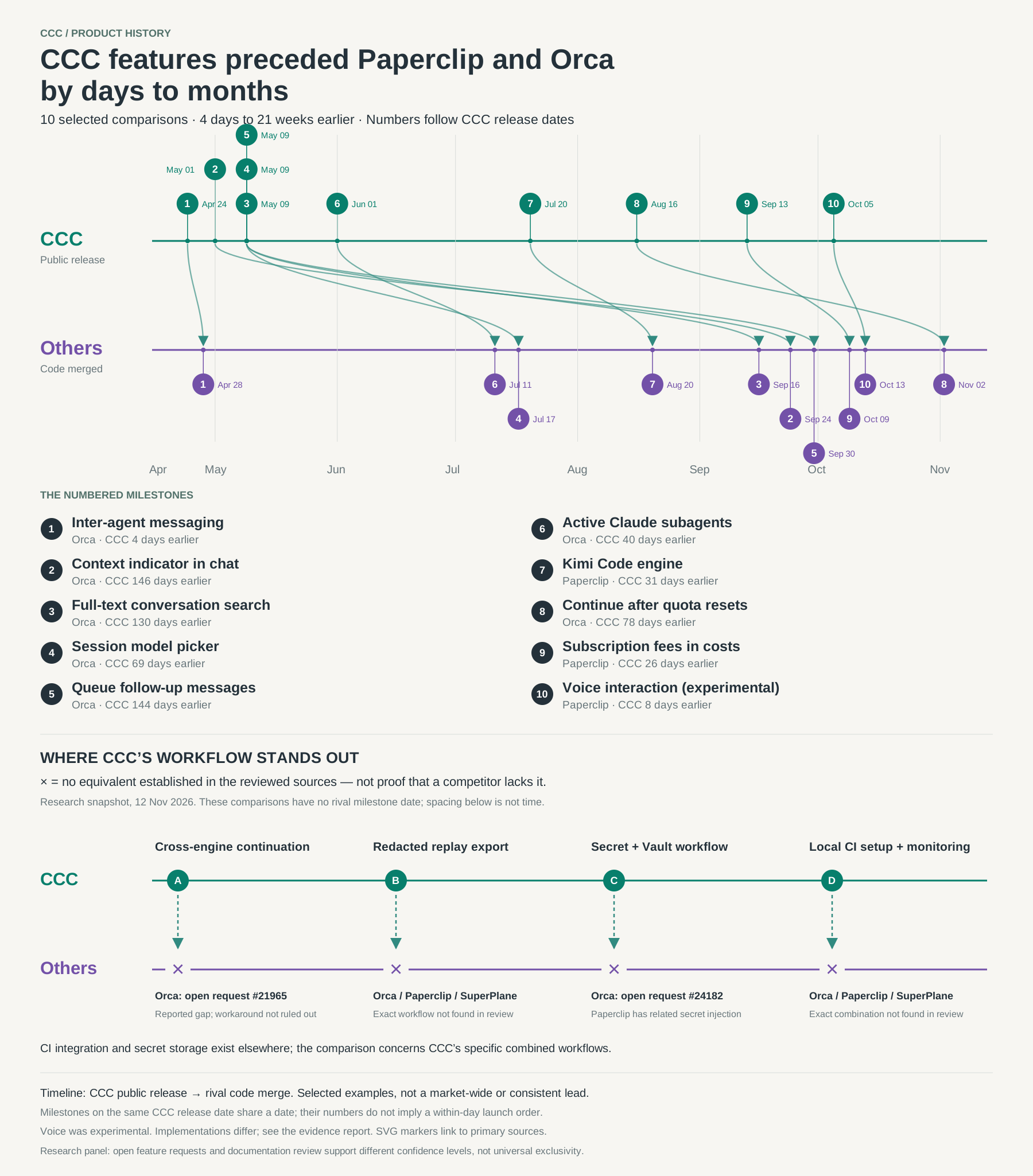
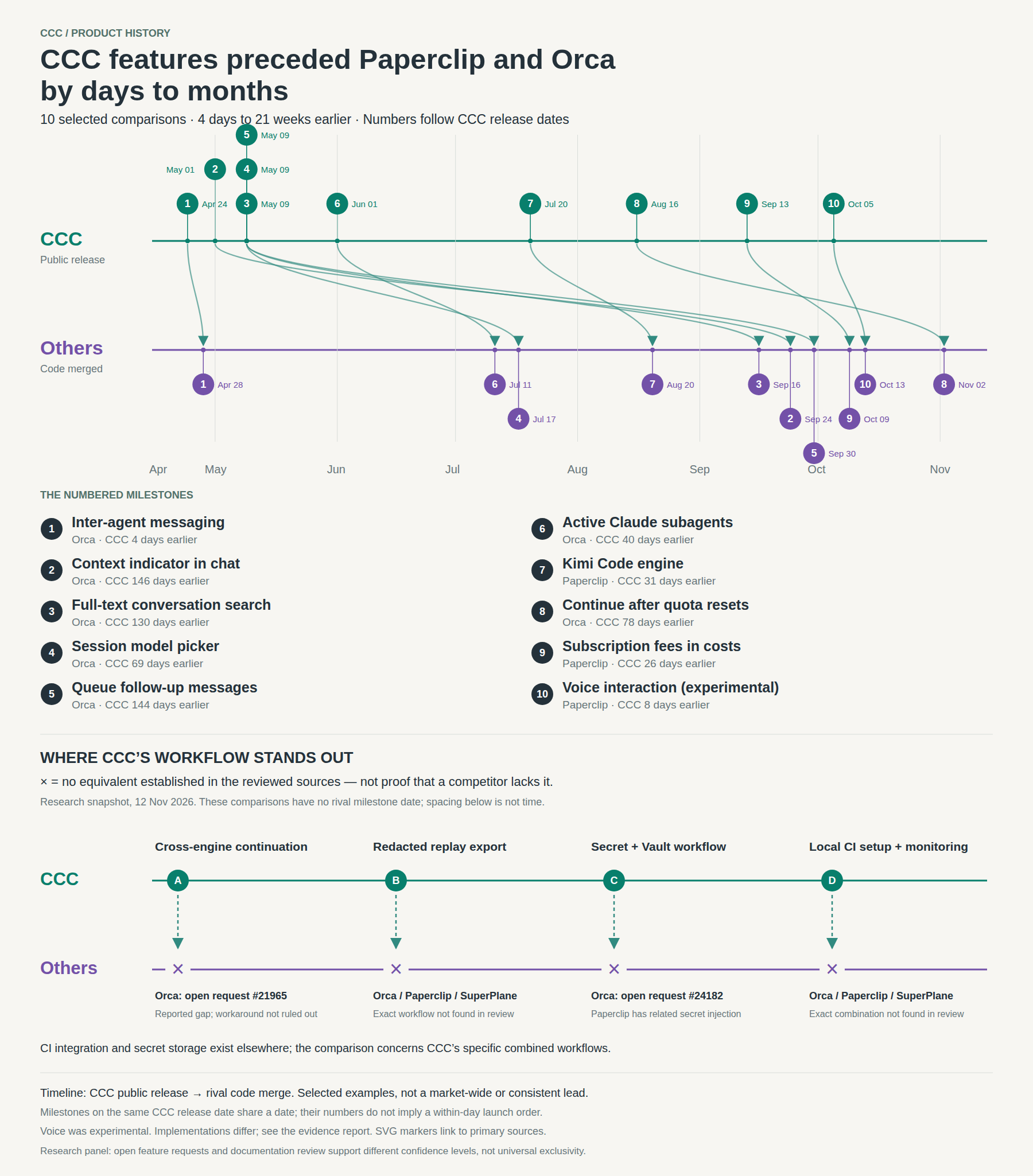
Ten selected comparisons, with leads from 4 days to 21 weeks. Matching numbers connect each CCC release to the named competitor’s later code merge. The numbers follow CCC release dates; features released on the same date have no implied within-day order.
Research snapshot: 12 November 2026. This is a selected set of examples, not a comprehensive ranking or a claim of consistent market-wide priority.
Full-size PNGDownload PDFSVG with source links
Dates and primary sources
We compare CCC’s published GitHub release with the rival implementation’s merge date, giving the rival its earlier code milestone instead of waiting for a packaged release. Leads are UTC calendar-day differences. Earlier private versions, external plugins and arbitrary CLI passthrough were not assessed.
| Feature | CCC released | Competitor merged | Lead |
|---|---|---|---|
| 1. Inter-agent messaging | 2026-04-24 v0.1.2 | Orca 2026-04-28 | 4 days |
| 2. Context indicator in chat | 2026-05-01 v2.0.0 | Orca 2026-09-24 | 146 days |
| 3. Full-text conversation search | 2026-05-09 v3.2.0 | Orca 2026-09-16 | 130 days |
| 4. Session model picker | 2026-05-09 v3.2.0 | Orca 2026-07-17 | 69 days |
| 5. Queue follow-up messages | 2026-05-09 v3.2.0 | Orca 2026-09-30 | 144 days |
| 6. Active Claude subagents | 2026-06-01 v4.4.0 | Orca 2026-07-11 | 40 days |
| 7. Kimi Code engine | 2026-07-20 v5.9.0 | Paperclip 2026-08-20 | 31 days |
| 8. Continue after quota resets | 2026-08-16 v5.25.0 | Orca 2026-11-02 | 78 days |
| 9. Subscription fees in costs | 2026-09-13 v5.33.0 | Paperclip 2026-10-09 | 26 days |
| 10. Voice interaction (experimental) | 2026-10-05 v5.37.0 | Paperclip 2026-10-13 | 8 days |
What each comparison covers
- 1. Inter-agent messaging — A running agent can send work/questions to another agent. CCC spawn/inject/ask versus Orca send/check/reply. Not a claim that their orchestration systems are identical. CCC implementation.
- 2. Context indicator in chat — An app-rendered context-use indicator next to the conversation/composer. Excludes a terminal showing the underlying CLI statusline; Orca PR explicitly distinguishes these surfaces. CCC implementation.
- 3. Full-text conversation search — Full-text search across stored transcripts with matching snippets. CCC v3.2 bundles its own indexer, so this comparison does not rely on the earlier external-index integration. Orca tab-title search is not transcript-content search. CCC implementation.
- 4. Session model picker — Per-session model picker without switching to the terminal: CCC live Claude /model and next-resume overrides; Orca native-chat per-session options. This comparison covers model selection, not identical effort/fast-mode controls. CCC implementation.
- 5. Queue follow-up messages — App-owned follow-ups held until the active turn/process finishes. CCC Codex/Gemini automatic queue drain; Orca native-chat host queue and composer cards. Excludes an input going directly into the underlying CLI; does not claim CCC already had all Orca edit/pause/steer semantics. CCC implementation.
- 6. Active Claude subagents — Discover Claude Task spawns, descriptions and working/done status. CCC chip/status panel versus Orca child rows. This is subagent visibility, not proof of identical predecessor/successor lineage. CCC implementation.
- 7. Kimi Code engine — First-class Kimi Code CLI integration, including ACP streaming, session execution and permissions. Kimi model API access alone does not qualify. CCC implementation.
- 8. Continue after quota resets — Automatically send continuation after a provider usage limit resets, with countdown/cancellation. Excludes a manual Continue button, ordinary retry, and scheduled task pause/resume. CCC implementation.
- 9. Subscription fees in costs — Subscription-aware dollar reporting beyond API list-price equivalents. CCC allocates configurable plan fees to sessions; Paperclip reports monthly account fees alongside API spend. Shared outcome, different accounting granularity; neither is a claim of exact per-session billing. CCC implementation.
- 10. Voice interaction (experimental) — Experimental browser voice interaction with the agent workspace. CCC voice reads workspace state and proposes actions; Paperclip uses Speko personas bound to task agents. Both are two-way voice, not dictation or TTS. Does not claim identical phone-call or task-binding support. CCC implementation.
Four distinctive workflows under review
The lower panel is a research snapshot, not a timeline. Its spacing does not represent time. No rival launch date was established for these workflows, so they are not additional dated leads. Public-source review cannot establish that a feature is absent from every product.
A. Cross-engine task continuation
CCC can move work to another engine with a context handoff and session lineage. This starts a new session rather than replaying native transcripts across providers. Orca issue #21965 remained open at review time and requests a comparable provider-exhaustion handoff. An open request supports a reported gap; it does not rule out workarounds or later implementations.
B. Local redacted replay exports
CCC exports local HTML and PNG replays, with redaction and filtering for supported human-authored messages. No equivalent complete workflow was found in the reviewed Orca, Paperclip and SuperPlane material. Paperclip’s company export serves a different portability purpose. This is a documentation finding, not proof of absence.
C. Secret + Vault
Masked credential requests and Vault process injection let users supply service credentials outside agent chat. Orca issue #24182 remained open and requests related secret-store and injection capabilities. CCC does not claim all the project/host scoping requested there. Paperclip already supports secret approvals and environment injection, so generic secret storage is not exclusive.
D. Local CI setup and monitoring
CCC combines agent-assisted runner setup with local GitHub Actions step progress and recent outcomes on desktop and phone. The setup button starts an agent; it does not guarantee a completed installation. No equivalent complete combination was established in the reviewed material. Orca has PR checks and failure-to-agent workflows, and SuperPlane has CI/CD integration. Generic CI integration is not unique. Paperclip’s Native Runner is an agent execution runtime, not evidence of the same CI monitor.